


Natural Disaster Science Division
Natural Disaster
Science Division
Understanding the mechanisms of natural hazards
and advancing science for a more resilient society.
We study natural phenomena related to earthquakes, volcanic eruptions, tsunamis, climate and environmental change, the water cycle, and sediment dynamics to understand the processes that cause natural disasters. By integrating geoscientific observations, big-data analysis, and numerical simulations, we seek to clarify their mechanisms, occurrence conditions, and variability. Through collaboration across the three research groups, we promote interdisciplinary research and share our findings with society, contributing to scientific progress and strengthening the foundation for disaster prevention, mitigation, and rational disaster response.
Overview
- Earthquakes, Volcanoes,
and Tsunamis - We investigate the mechanisms of earthquakes, volcanic eruptions, and tsunamis by developing original methods to rapidly and accurately characterize complex earthquake rupture processes and by applying insights from petrology and sedimentology.
Through this research, we aim to strengthen the scientific foundation of hazard research, communicate our findings promptly to society, and contribute to disaster prevention and mitigation.
- Climate and Environmental Change
- We investigate the mechanisms driving climate and environmental change, carbon cycling, and ecosystem dynamics. Our research addresses monsoons, the East Asian rainy season, extreme weather, and the future evolution and predictability of extreme events. By integrating insights from exceptionally warm periods in Earth’s history, we also contribute to long-term projections of environmental change under continued global warming.
- Water Cycle and Sediment Dynamics
- We investigate natural phenomena related to the water cycle and sediment dynamics, with the aim of understanding their underlying. We examine processes from precipitation, groundwater, and river runoff to slope failures and sediment transport across multiple spatial and temporal scales, integrating hydrology, geomorphology, and erosion and sediment control engineering to clarify watershed responses and strengthen the scientific foundation for disaster prevention and mitigation.
Promoting Interdisciplinary
Research
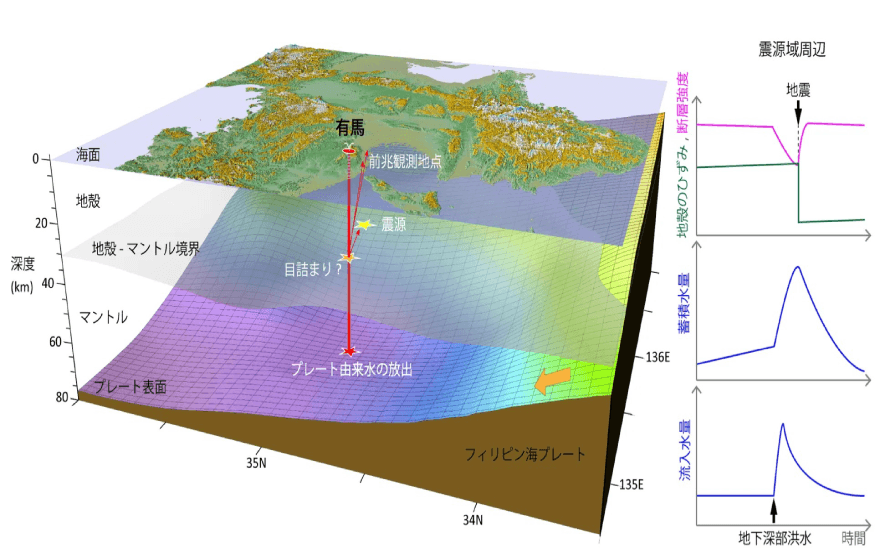
- Understanding the relationship between deep fluids and earthquake generation(Yamanaka & Adachi, 2024)
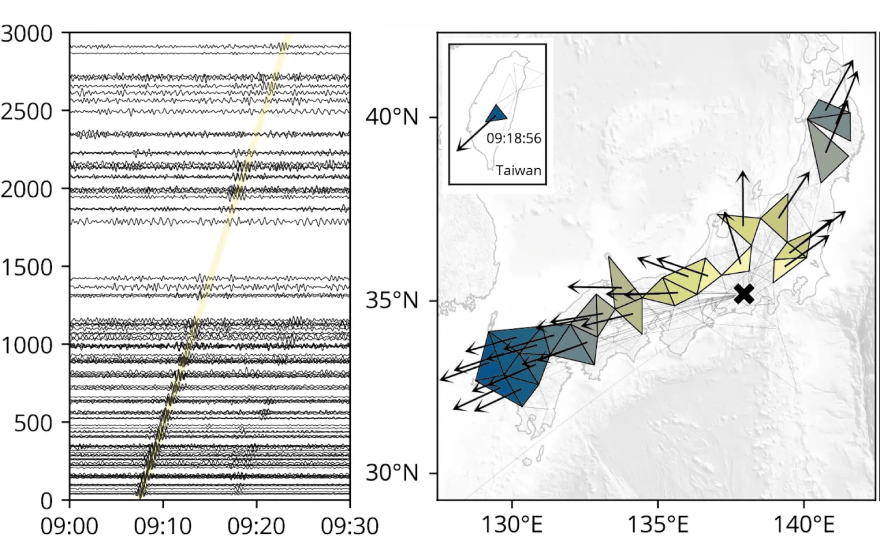
- Using seismic waveforms to investigate sediment dynamics and identify landslides(Okuwaki et al., 2021)
Mission
- Understanding the mechanisms of natural hazards and advancing science for a more resilient society.
Members
- Earthquakes, Volcanoes, and Tsunamis
- Yuji Yagi, Kei Ikehata, Ryo Okuwaki, Shigehiro Fujino
- Climate and Environmental Change
- Hiroaki Ueda, Yoichi Kamae,
Irina Melnikova, Hironao Matsumoto
- Water Cycle and Sediment Dynamics
- Taro Uchida, Takashi Matsushima,
Yamanaka Tsutomu, Tsuyoshi Hattanji, Yosuke Yamakawa
Selected Recent Research Topics
- JSPS KAKENHI Grant-in-Aid for Scientific Research (B)
- Linked reverse-fault ruptures along the Sea of Japan coast
- Regional recurrence of Nankai Trough megathrust earthquakes
- Non-earthquake seismic sources and waveform noise
- Early Cretaceous global cooling driven by large-scale volcanism
- High-resolution water isotope data and water-cycle analysis across Japan
- Rainwater storage and drainage in accretionary-complex mountains
- JSPS KAKENHI for Transformative Research Areas (A) “Wild Climate” and Humanity’s Past, Present, and Future
- Climate reconstruction of the past 2,000 years using climate models