


Space Life Sciences Division
Space Life Sciences
Division
Unraveling the Plasticity of Life Through Space Research Building Fundamental Science
to Support the Survival of Humanity and Earth’s Ecosystems
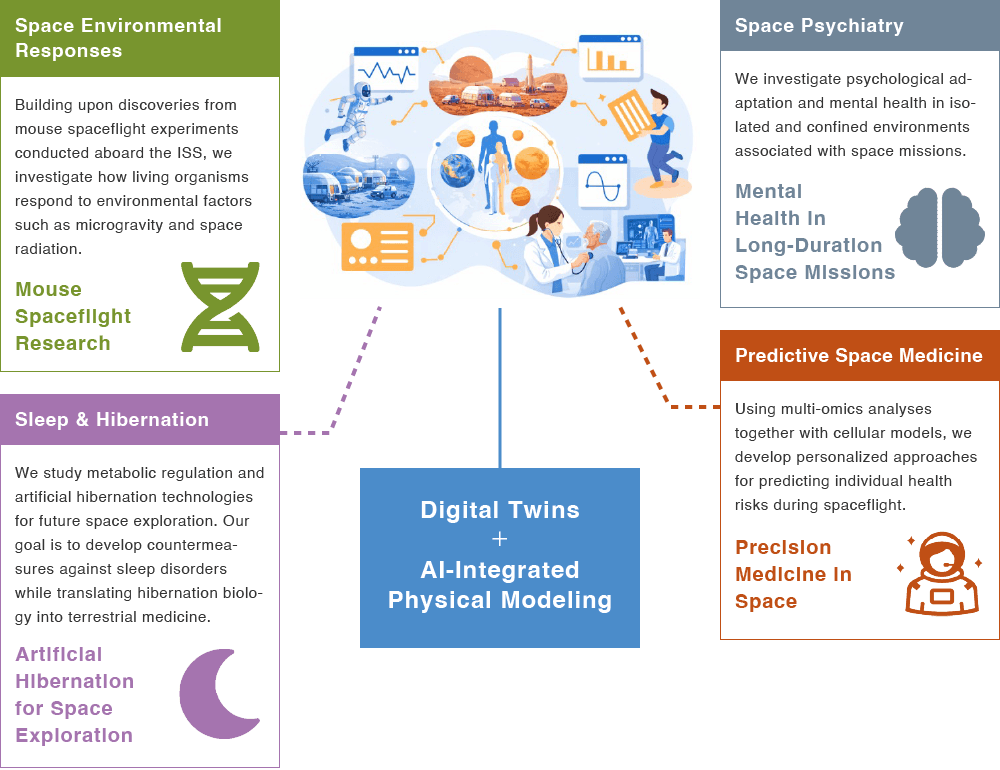
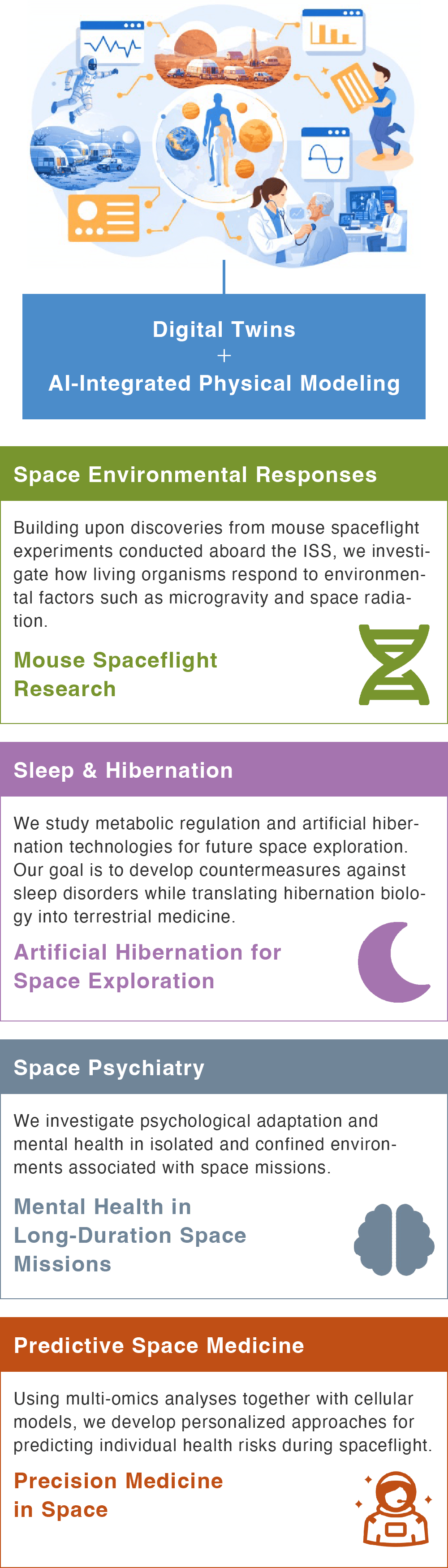
The Space Life Sciences Initiative integrates and expands the life science research jointly developed by the University of Tsukuba and JAXA through studies aboard the International Space Station (ISS). Centered on the Transformative Research Area “Life in Space” and the JAXA flagship project “Astronaut Digital Twins,” the initiative brings together interdisciplinary research in space biology, artificial hibernation, and space psychiatry, creating an international hub for space life science research.
Using extreme environments – including microgravity, space radiation, and isolated and confined habitats – as experimental platforms, we investigate both the plasticity and the limits of life. The knowledge gained will contribute not only to space exploration but also to terrestrial medicine and solutions to societal challenges. Ultimately, we seek to understand biological adaptation and the sustainability of future civilizations on the Moon and Mars while establishing a globally recognized center for expanding humanity’s capacity to thrive beyond Earth.
Overview
Mission
- Develop next-generation experimental platforms beyond the ISS
- Lead international collaborations with commercial space stations and lunar/Martian exploration programs
- Establish the scientific foundation of Predictive Space Medicine
- Build standardized data platforms for space life sciences
- Advance life-risk assessment for deep-space exploration
Faculty Members
- Space Health Prediction
- Masafumi Muratani
- Space Environmental Response
- Satoru Takahashi, Takashi Kudo,
Ryo Fujita
- Sleep & Hibernation
- Takeshi Sakurai, Yuki Saito,
Shingo Seiya
- Space Psychiatry
- Shinichiro Sasahara, Shotaro Doki, Daisuke Hori
Recent Research Programs

- Life in Space
Transformative Research Areas (A)
Understanding the robustness of environmental response and regulatory systems to predict the future of life on Earth.

- JAXA Mouse Spaceflight Missions
MHU-1,4,5,8
JAXA Cell-Free Epigenome Mission

- Hibernation Biology 2.0
Transformative Research Areas (A)
Mechanisms of torpor and hibernation.